
We should always be mindful and focus on the moment because good or bad , that moment will pass. It can be comforting to revisit fond memories of those youthful years even though they can sometimes make you feel a little sad as you lament the passing of time. Memories become distant or distorted with the passage of time and what we remember about an experience remains a memory of a memory. As the Japanese proverb goes, ichigo ichie. According to Google ‘Literally, ichigo ichie means “one time, one meeting”, but it can be translated as “one lifetime, one encounter” or even “in this moment, an opportunity”
I wanted to visit New Zealand and I wanted to do a solo trip but I was not as adventurous as I had thought I would be. I signed up for a two weeks Newmans tour package that took me to both North and South islands that are separated by Cook Straits. That was in the early eighties. Aside from a mother and daughter duo, a Thai couple and an American couple, all the other tourists in the group were also travelling alone. I remember sharing a room with a Scottish lady who was in her seventies. She was doing some writing. At the time I was studying law and I had not thought much about my interest in writing even though I had dabbled in writing plays and stories in Chinese language as a teenager. As a young person in the group, everyone was sweet and kind to me . The Thai couple missed Oriental cuisine, and whenever we were in a city where there was a chance that we might be able to get some Chinese food, they would invite me along. They would not have known that I had preferred bread to rice and I love butter and cheese. They were kind and it would have been impolite to turn down an invitation. It was indeed a memorable trip for me and New Zealand is full of fabulous places to visit.
After graduating, I harboured a dream of opening a café when I returned to my hometown. With changing social and food landscapes , I had also harboured dream of becoming a food critic and writer, imagine dining out is part of your job. I particularly enjoyed reading My Life in France by Alex Prud’homme and Julia Child and Ruth Reichl’s memoirs, Garlic and Sapphires and Comfort me with Apples. I have done none of that because I do not qualify as a foodie even though I enjoy food that is palatable, comforting and appeasing visually to whet my appetite.
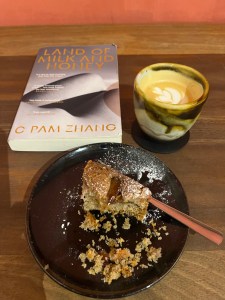
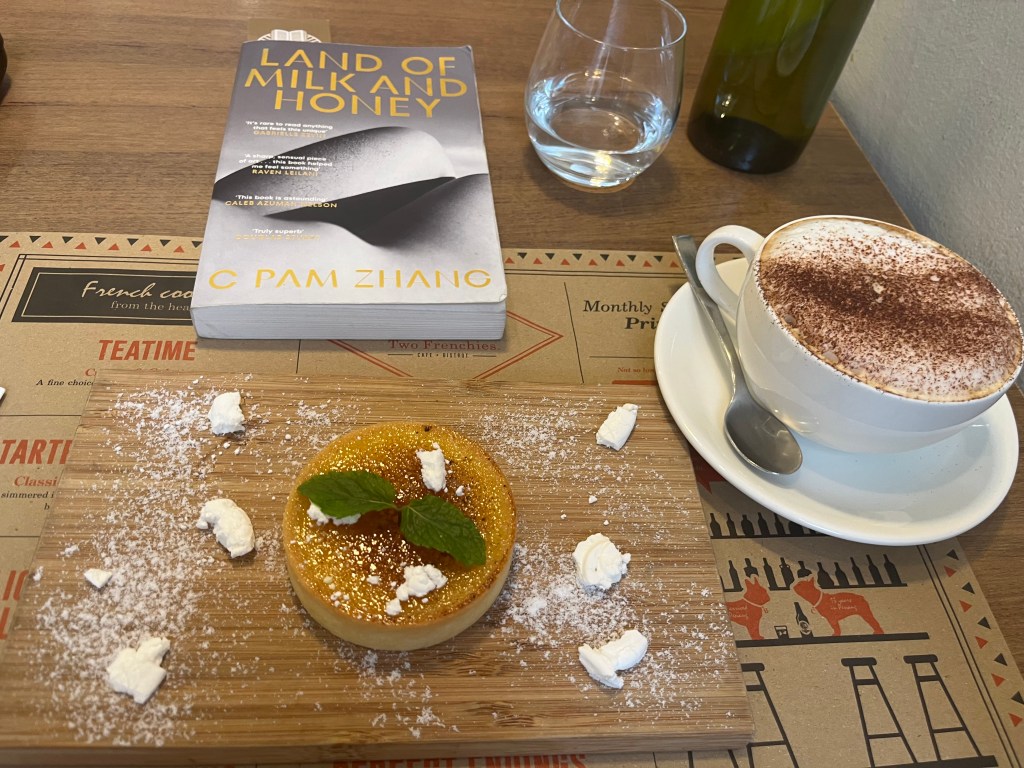
Land of Milk and Honey by C Pam Zhang is a dystopian tale about pleasure and wonder of food. It is a haunting and stark tale about a young chef who lives for the pleasure of food. A smog has spread and the chef has escaped to a mountain top colony in Italy where the sky is clear and food is abundant. It is pure decadence when the world is in trouble due to ‘the smog that spread from a cornfield in Iowa and soon occluded the sun, smothering as it went fields of wheat in Canada and paddies of hard yellow rice in Peru. No more lemon trees fragrant on the slopes of Greece, no more small sweet Indian mangos. Biodiversity fell. Wildlife and livestock perished for lack of feed.’
The protagonist, twenty-nine years old, hails from California and is now adrift and stranded in England since the America’s borders have been closed. She was born of Chinese mother and Korean American father. Her mother was born poor in rural China and managed to win a scholarship to study medicine in Beijing. Then she won a coveted visa to America where she met her husband,’ a handsome Korean American entrepreneur who turned out to be a wife-beating shithead who walked out‘. But the young chef defies every dream of her mother for her and becomes a cook. Her mother said “You will be a kind of servant.” Her mother was an awful cook as ‘sustenance mattered over taste‘ ‘She saved the water from soaked beans. She stewed the flesh of November’s discount Halloween pumpkins.’ When she cooked for her mother, the latter asked. ‘Where are the bones. The head.’ When she packed and leave, the plate she’d made for her mother was till pristine, but colder and she heard her mother say, “Selfish. Who are you?‘ According to her mother, ‘raw meat will kill you . French food is not made for us, too heavy, it will kill you.’She was also told that her lack of respect for thrift, severity and real work would kill her.
She has to leave where she is when she finds that she has to cook pesto with flour.

‘Chef had lost its meaning, like lucky, like fresh, like soon. No saffron, no buffalo meat, no polished short-grain rice. Dishes winked out from menus like extinguished stars as a conservative, nativist attitude seized the few restaurants that remained open thanks to government subsidies. As they shut borders to refugees, so countries shut their palates to all but those cuisines deemed essential. In England, the shrinking supplies of frozen fish were reserved for kippers, or gray renditions of cod and chips—and, of course, a few atrociously expensive French preparations with which a diner might buy, along with sour wine, the illusion that she still lived in luxury. Back to stodgy safety. Back to national dishes unchanged for hundreds of years. The loss of pesto should have come as no surprise in a world with no favas, no milkfish, no Curry Lane in London or Thai Town in LA, no fusion, no specials of the day, no truffles turned out like sheepish lovers from under their blankets of sod. We were lucky, those around me said. We survived.‘
As she can no longer see a future for the halibut dish without pesto, she has to quit that job at the seafood restaurant. Furthermore, this is the day when a letter has arrived for her from California telling her that the apartment left by her deceased mother in Los Angeles has burned down. But when she applies for the private chef position for the community that advertised itself as an elite research community, she does not know what she is going into. While she specializes in French inflected cooking, due to her lack of experience, she lies in her resume when she applies for a job that calls for ‘a formally educated French-trained chef capable of working with unusual ingredients and turning out exquisite haute cuisine‘. When she is accepted, she is picked up by private jet and heads to the mountain and the restaurant is built on a cliff above the acidic smog line.
It is an elite community on a minor mountain at the Italian -French border, funded by private investors and populated by scientists, medics, field hands and staff who are employed to bioengineer food crops capable of withstanding smog. It is at-will ten-week contract with no guarantee of a long term visa, yet she goes for it simply for the job’s promise of fresh produce. For pleasure, there is always a price. Her new engagement comes with several conditions, inter alia, she is not to leave restaurant grounds without approval, non-disclosure agreement, no phone, no internet, no contact and no family.
She meets the mysterious employer with dead shark eyes and his visionary pretty daughter, Aida who speaks in flawless British English. The man’s British English voice, ‘hyperarticulated to the point of sounding like a GPS‘. She finds out that she is engaged not for her cooking skills but for her Asian, more particularly Korean descent. The employer knows that she has not attended Le Cordon Bleu nor run the kitchen at Coloniál so she is offered a salary ‘forty percent less than if her résumé had been truthful‘. Her directives have finally boiled down to becoming Eun-Young, a Korean woman who used to cook for their diners. Eun-Young, a Korean was married to her employer and is Aida’s mother. Eun-Young has left ( might have been killed by the employer) and the chef is to replace her. Eun-Young is religious and the young chef has to take her place and she has to perform the rituals just as Eun-Young did.
While she is at the mountaintop colony , the unnamed protagonist is awakened to all her senses and the pleasures of taste, touch and her own body.
C Pam Zhang is a prolific writer and her prose is beautifully executed. The narratives in Land of Milk and Honey are haunting and as you read on, you feel the ominous atmosphere and wonder about the sanity of the protagonist. You will root for her safety even if you may not warm to her character.
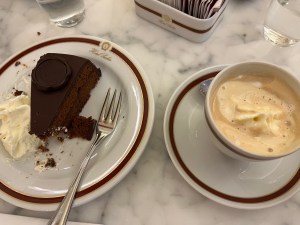
sacher-torte, Hotel Sacher, Vienna,September 2023
Reading Land of Milk and Honey has somehow brought me back to a memory of one gastronomic experience that I had from more than a decade ago.
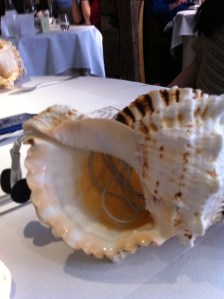
In April 2012, my family and I had a meal at The Fat Duck in Bray,Berkshire, England. We had the most amazing multi-sensory dining experience. Heston Blumenthal has created a dish called ‘Sound of the Sea‘ where you are presented with seafood served with edible sand, seashells, shellfish and sea foam that resembles a scene from the sea. Everyone of us also received a conch shell and inside each of these shells was an iPod that came with headphones and you would hear waves crashing, seagulls, distant chatter as if you were somewhere on the beach. Blumenthal‘s style of cooking is playful and innovative. It is about how food works and it is designed to engage your senses as you savour your dish.
Heston Blumenthal is self taught and it is his childish curiosity about how things work and amateur obsession with science that have contributed to the meteoric rise of The Fat Duck from its humble beginnings to its third Michelin star. Whether it is about how smell can affect taste or what different flavours mean on a biological level or how temperature is distributed, Blumenthal has experimented with various techniques and reinvented cuisine to be not just an art but a science. It is definitely a unique dining experience for a foodie.



 Bookaholic Macchiato