
Two months ago, when my lower arm was immobilized in a full cast for six weeks due to a wrist fracture caused by a fall, life literally slowed down. My morale has been rather subdued and even a little crushed whenever relatives remind that one has to be more careful as one advances in age or that age might even have or had something to do with the fall. While I do acknowledge that our level of energy may deplete with age and that body may become fragile and less flexible, I would think that I was distracted at the time and the fall resulted from a momentary lapse of attention. You cannot fault others for their remarks because this is how they think and what they believe. I need to be diligent with the exercises that work on normalizing my wrist and hand.It would be some time before I could hit some tennis again . In the meantime, I am happy that I can still make my cup of espresso from freshly ground coffee beans in the morning before I get on with the day ahead. Guess I must be patient and not be obsessed about winning and progress.
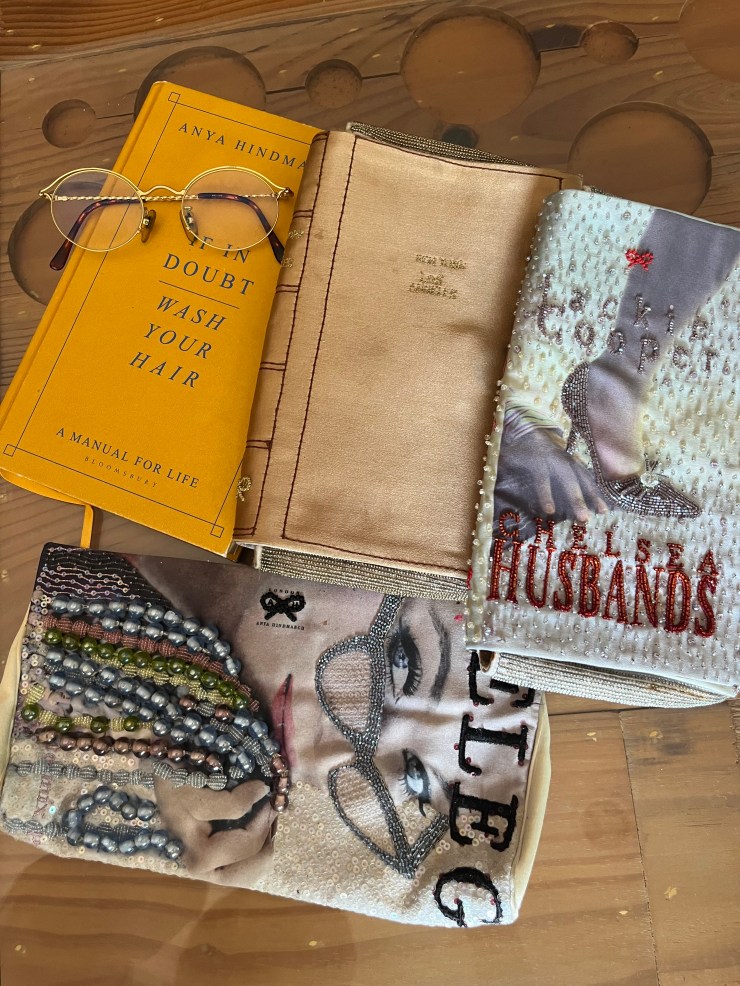
In her memoir entitled When in doubt wash your hair ,Anya Hindmarch writes about how she and her husband organised care for her mother-in-law by getting live-in carers when the latter became forgetful and vulnerable to live on her own. In retrospect she feels shame that what they did was possibly invasive and insensitive on their part and in their attempt to be kind and to make it all work for them. She muses, ‘We were actually disempowering and infantalizing my lovely mother-in-law. A bit of me thinks that in my anxiety to make it work, and my guilt that we couldn’t be there ourselves, I was focused more on getting it covered and not enough on what Liz wanted.’
‘ The moment you let a person feel they’re not in control any more, that’s when they really age and really decline.’ – Anya Hindmarch
That is so true.
At times cooking and baking can be therapeutic but if you ask me to do that daily, I would not be able to do that because I find cooking, cleaning and housekeeping tedious and difficult.
In Lessons in Chemistry, Bonnie Gamus has created a protagonist who regards cooking as science.

It’s the early fifties. Chemist Elizabeth Zott is working as a Lab Technician at the Hastings Research Institute. She meets Calvin Evans, a rising star at the institute. Due to his brilliance he is given a large lab. He has authored sixteen scientific papers and invited to conferences and he has turned down a fellowship at Harvard. At twenty-four, due to his breakthrough on the reactivity of dibenzoselenophene , he appears on the cover of Chemistry Today. They fall in love and decide to live together. Zott turns down Evans’s proposal as she does not want her work to be credited to Evans. They adopt a dog and name it six-thirty. Zott buys a leash for the dog to comply with a local law, unfortunately when Calvin takes the dog for their evening walk one fateful evening, some sharp loud explosive sound startle the dog and cause it to run in direction opposite to Calvin’s direction. The leash leaves Calvin no room for compromise and he steps on motor oil, slips and gets run down by a patrol car. Zott is devastated and when she is pregnant, she is kicked out of the institute.
Zott is a fiercely independent woman who is inclined to bend rules, particularly with regards to gender roles and what is expected of a woman. Now that she is a single mother and is in need of work, she sets up her home lab and provides consultation services for a fee to her former colleagues who encounter problems with their ongoing projects.With the help of her neighbour, Harriet ,Zott manages to do her work. She believes in home cooking and prepares a wholesome packed lunch for her daughter, Madeleine when the latter attends pre-school. Her cooking talent is uncovered by a preschooler’s father who signs her on as the host of a cooking show,Supper at Six. With great reluctance, she has to shelve her own work and becomes a TV host. She approaches cooking in a scientific way with a running commentary making references to molecules and using terms like H 2O and sodium chloride instead of water and salt. She prepares nourishing meals and asks the viewers to use fresh ingredients and not ready made soup such as the ones mass produced by one of their sponsors, defeating the purpose of advertisement.
Elizabeth Zott is a perky and quirky character who knows her own mind. She follows her own script.

‘”It’s steak night,” Elizabeth said,”which means we’ll be exploring the chemical composition of meat, specifically focusing on the difference between ‘bound water’ and ‘free water’ because – this may surprise you,” she said, picking up a large slab of top sirloin,” – meat is about seventy-two percent water.”
She tells the audience that water is the most common molecule in our bodies because it makes up sixty percent pf our composition and we may be able to go without food for up to three weeks but not days without water.
The housewives find themselves getting an education and daring to change their status quo.
I read that Bonnie Garmus started writing the story in Lessons in Chemistry after a bad day at work. Gamus had been a creative director and a highly experienced copywriter in the tech industry. One day, she was greeted with silence after giving a representation for a million-dollar campaign to a room full of male colleagues. But when a man unknown to her stood up and read her entire representation saying what she had said , he was congratulated upon. He ignored her when she said she had already said all that. It is apparent that Garmus had channelled her anger in a positive direction. Lessons in Chemistry was published in April 2022 when Bonnie Garmus was sixty-four years old. It is her debut novel. It has been developed into a drama miniseries.
Really Good Actually by Monica Heisey is a tender bittersweet comedy about Maggie, aged 29, a PhD student, struggling to cope after being separated from her husband of 608 days. They had been together since they were nineteen years old. But when Maggie suggests that they break up and get a divorce, Jon agrees without hesitation.
Maggie now regrets that she has asked Jon for a divorce. After Jon has moved out of their rented place, she can no longer afford the lease. It is her ‘first time, ever, living alone‘.She finds herself on an emotional coaster ride and ends up ordering and eating hamburgers at 4 am, getting on dating apps, intermittently dating, having casual sex, going on spending and shopping spree as she imagines a life she does not have. Then when her credit card arrives, she returns everything and gets practical by looking for a place to rent. Thanks to Amy (newly divorced but navigating better than her),her friends’ intervention and her academic advisor, Merris, who is kind to offer her the basement suite of a house where she shares with two other professors. She can even stay rent-free for the first month on condition that she walks one of the housemate’s Great Dane while the housemate recovers from a foot operation.
Set in Toronto,the narratives are in the first person. Maggie is going through a rough patch in her first year of divorce. She finds herself asking: Why do we still get married? Did I fail before I even got started? When Maggie looks for a place to rent, this is how she describes herself:
‘I tried my best: I am an average-height, red-headed academic with anaemia. I’m halfway to being a vegetarian, on weekends. I’m left-handed and shortsighted. Technically speaking I am an “average sized” woman—still, it is very difficult for me to buy trousers, like it seems impossibly hard, and I don’t totally understand who trousers are for, if not average-sized people in general. I have no opinion on “the outdoors.” My politics are leftist ,which so far has mostly meant that I sign a lot of petitions and donate small amounts of money to people who are working harder than me at solving the Problems or go to protests and attempt to stand in solidarity with people the Problems are happening to. I go to one festival a year despite not liking live music. I’m not sure I’m bisexual enough to “count.” I’m an ENFJ, or an INFJ, or an ENFP . . . I have taken the test many times. I read a lot of books and own a number of tote bags that makes that clear. I cycle. I’m the baby of my family (not by birth order, but you know). I’m jealous of people in more useful careers, even though useful careers seem like a lot more work. I think most intelligent people are a little bit mean, and all nice people are a little bit stupid. I wish I didn’t think that. I’m working on not thinking that. I have bad posture and good blood pressure. I’m heartbroken.‘

Maggie is hilarious. She meets Lori the divorce lawyer who charges $215 an hour. She tells the lawyer that she can use some of the money they were given as wedding presents to cover their various legal fees.
In Maggie’s voice,
‘I told the lawyer, a kind-faced, soft-spoken family friend of a friend called Lori, that I supposed Jon and I could use some of the money we’d been given as wedding presents to cover our various legal fees. She laughed – a short, sharp honk – then grew very serious: ‘Ah, you’re not joking.’
Lori opened one of several folders as a young woman wearing the kind of trousers that are begging to be called ‘slacks’ brought her a coffee.”Thanks, Lindsey,’ she said, taking a sip.Lindsey left, grabbing a few folders as she did. From my limited time at the offices of Janson Parker Stevenson, LLP, it seemed that the legal profession was essentially a very sophisticated folder management system. Lori’s walls were lined with shelves displaying certificates and leather-bound books and photographs of smiling children I took to be hers. I shifted in my chair, trying to appear competent and grown up and like I wasn’t wearing a stretched-out tankini top as a bra.‘
As Taylor Swift’s songs will tell you all about the unreliability of love, you know how that feeling that once made your heart soar and everything looking so fabulous might just vanish and you have to grow up and be adult about whether to stay or call it quits. Maggie may be a millennial but heartbreaks are all part of life journey no matter what generation you are . For her, life may not have turned out the way she has wanted it, she has family and friends who love and care for her.
Monica Heisey is a screenwriter for Schitt’s Creek and Working Moms. Really Good Actually is Heisey‘s debut. I read that It is based on her real life but it is not a memoir.

 Bookaholic Macchiato