
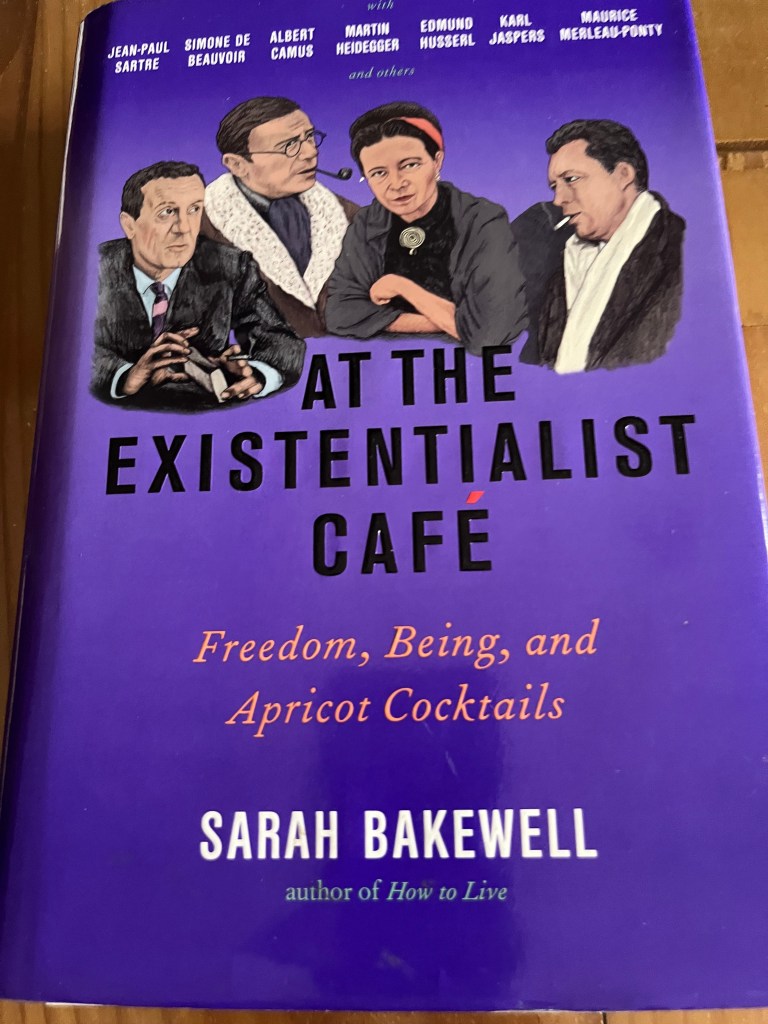
Existence precedes essence or essence precedes existence? Decades ago, I read Age of Reason by Jean Paul Sartre when I was at the varsity. Can we be anything we choose to be? What I gather from sporadic reading about existentialism in my youth is existence precedes essence. Sartre propounds that an individual’s essence is defined by the individual through how he or she lives his or her life. You create your own purpose and you give weight to your existence, life otherwise is meaningless. You like to think that you are free to become who you choose to be but can you really be in charge and be your own authentic self? You may choose your own values but can there be absolute freedom to create the world that you desire? In this fast moving high-tech world, we are definitely confronted with compelling questions of identity and freedom. What these existentialist thinkers say will be relevant.

Sartre passed in 1980. Since then within a span of four to five decades, science and technology have taken such a huge leap. We are now in this information age where we may easily lose a sense of who we are as we are very distracted by all that is going on every day. At the same time the pharmaceutical industry, medical science and genetic engineering are also making such progress in monitoring our genes and modifying our biological makeup to better health care, genes selection and longevity. The cautionary tale of Brave New World by Aldous Huxley is gradually becoming a reality or as it happens, it is already happening.
As a child, we were asked to write essays about what we wanted to be when we grew up. The idea was more about the kind of occupations or jobs we were going to have. What did we know about life then? I have been told that students these days write that they want to be influencers. At the outset, it does sound hilarious but then what do they know about engaging in any kind of the jobs . For most of us who have the privilege of furthering our education, college life is the best because you live the adult life without the real responsibilities of being an adult. Aside from desiring to live a good life, you look back you imagine the alternate lives you might have lived , had you not made certain choices. No matter what happens, we try to make the best of the moments we have on this planet earth.
In the British film Living that is a remake of Ikiru (“To Live”) , a Japanese film by Akira, a bureaucrat at public works department finally finds his purpose after being diagnosed with terminal illness. He rallies the various departments to approve the construction of the children’s playground on a WWII bombsite when previously he would not have processed the application . That gives him a sense of fulfilment in his final days. Living is a film touching on the themes of loneliness, mortality and legacy

Real Americans by Rachel Khong is a family epic about identity, fate and the choices the characters have made. Lily Chen only wants to live the American dream in New York City but her scientist parents imagine so much more for her. Lily’s parents fled Mao’s cultural revolution with a view to pursue a better life in America. Lily was born in America and her parents were determined to fit into their adopted country. They speak only English to Lily when she was growing up.
The story begins with the precipice of Y2K. Lily is an unpaid intern at a media job, she can barely make rent. She meets Matthew Allen Maier, a young and handsome financier who can give her a fairy tale life of luxury. When she discovers something about her ambitious mother and how she had worked with Matthew’s father,Otto in some genetic experimentation involving her and Nick, she implores Matthew to leave his family together with their son, Nick Chen. Lily ends up raising Nick on her own on an isolated and close-knit island in Washington State. Nick knows that his mother is hiding something from him.
In high school, Nick Chen and his best friend Timothy dream of breaking free from the island so they study hard. Timothy urges Nick to find his father through DNA test. When they both pool together their earnings from their jobs with Farmer John oysters grower, they order a DNA test for Nick. Timothy quits the job as he misses sleeping in but Nick continues on as he likes being paid so he can also order a DNA test kit for Timothy. One of his jobs is beating the oysters with baseball bats, so their shells would chip and grow in a curved cup shape. The restaurants prefer that because the curved shells are easier to hold.

When Nick and Timothy receive their DNA test results, Timothy’s dark curly hair and hazel eyes are correctly predicted but not Nick’s hair and eyes. The predictions about Nick’s hair and eyes being brown are wrong because his hair is blond and his eyes are blue. Nick is 50% Chinese and the other half is German, English and a tiny bit Swedish. There is a lack of interesting information as the closest relatives on the website are a third or fourth cousin. Then one day he receives an email from DNA test company saying that he has a new message from one Matthew. Nick’s father has been given the DNA test kit as a gift and now is pleased to make his acquaintance. Matthew works for his family’s foundation and is in venture caplital, investing in startups. They start exchanging emails and when they finally meet, Nick is a replica of his father. Nick meets his father without letting his mother know. When he is worried about college fee, Matthew’s dad gives him a credit card with the name on it that says”Nico Maier”. Nick lacks extracurriculars and Chinese is his only foreign language, he does not stand a chance to get into Ivy Leagues with his less than perfect SAT score and grade point average, so Matthew asks him to consider using his last name for the applications. Timothy who has excellent scores gets the acceptance emails from all the Ivies- Harvard, Yale, Princeton and Columbia and he cannot make up his mind. To their surprise, Nick also gets acceptance emails from the Ivies.

The fiction is divided into three parts, and each part is narrated in the first person’s voice of the main characters in different years: Lily in 1999, Nick in 2021, and Mei in 2030.
In Nick’s voice, ‘ How could I say that I was afraid of who I’d be if I stayed? If I didn’t leave, I would stay trapped in a life as small and static as hers. When my mother said that Yale would be expensive, I told her I got a full scholarship.’
‘Timothy wanted Harvard, but I wanted Yale. Before, I might have changed my mind to agree with him, but now it was the other way around. I said that I preferred Yale, and there was no argument. He yielded. So what if I’d gotten in only because of my last name? I’d lived my whole life as a Chen, not a Maier.It seemed only fair that I this one privilege.’
At Yale, Timothy makes friends easily as he is comfortable with being gay and where he comes from. Nick finds it challenging to fit in and feels terrified by the private school kids in his humanities classes. Nick feels that these kids seem to be the people Timothy is always meant to be friends with and he feels ‘a flood of resentment’.They are growing apart. On top of that , Nick is struggling in every class so he spends more time studying. When he is home on vacation, he runs into Timothy’s father, who hopes the two boys are taking care of each other and he lies that they are. He tells his mother honestly that he does not know how Timothy is doing, his mother understands. People drift apart, these things happen.

Nick is now in high school about to sit for his SAT. When he finds his long lost biological father, he has a world of questions. Some of his questions are answered when he finally meets his long lost grandmother, May who has been estranged from Lily for more than two decades. May tells him about her life growing up in China in the 1960s, her passion in science and how she had to flee from China to America at the height of Cultural Revolution. Lily now fifty-three. ‘She had never been comfortable as a young person.’ ‘But she had never wanted to be remarkable.’
‘As a parent, she had sought to do the opposite of what her mother had done- not expecting Nick to resemble her, not burdening him with her expectations. And yet was she any different? Could love between a mother and child be anything less than completely overwhelming?‘
Now May is eighty-five years old. Nick has finally met her. Through Nick Lily now knows that her mother is alive.
May in her final days muses,
‘ The clock ticks loudly from the kitchen. Time passes, indifferent to me. So much of my life I have let slip by, because I have not attended to it. All this while, instead of seeking more time, I could have been paying attention. I notice it now, my present: my grandson’s kind face, his warm hand in mine, and the smell and sensation – here the words, in any language, fail — of being alive. Chinese is a language that exists in the present tense. In this way, it is unlike English, a language in which it is easy to say: I had a past, I will have a future. When I adopted English as my own I lived so much in the hope of what was to come. Now my future shrinks with each passing second.’
Real Americans almost four hundred pages, begins with Lily’s romantic story with Matthew. Rachel Khong has cleverly weaved an imaginative story that traverses through time. For me, the science element in it is not easy to understand but the story is primarily about Nick’s coming of age and the choices that his mother, Lily and maternal grandmother, May aka Mei have made in their respective adult lives. It is also about the rich who engage in genetic engineering and science with a view to change the genetic past, to live long and healthy and reorder the world. It is a story reminding us about the relationships that matter and what makes us who we are.

I read Rachel Khong‘s debut novel Goodbye, Vitamin several months ago . The story is about thirty year old Ruth Young whose life is falling apart when her fiancé , whom she quit college to follow him to California where he pursued a medical degree. She is blindsided when he leaves her for another woman, and she should have seen that their ten year relationship has been stagnant. She is disoriented as her career maternity ultrasound sonographers going absolutely nowhere. Her mom asks her to return to her hometown to help care for her dad who has Alzheimer’s. He was a beloved history professor but he has been laid off by reason of his ailing mental health. Theo, one of his students contacts Ruth and together they organise a fake course attended by a small group of students who want to support their professor to bring some normalcy and order into his life. Ruth’s father keeps a journal about the things that she had said as she was growing up. I can relate to that because I had also kept some entries about what my daughters had said when they were children.
Here is a snippet of such an entry.
‘Today we went over to your mother’s friend’s house for dinner. We’d asked you to be polite, so you said, ‘No more, please, it’s horrible thank you,'” reads one entry. Even cuter: “Today was my birthday, and you asked me how old I was. When I told you 35 you seemed stunned. You asked me if I started at one. Then you asked, When do we die?“
Now that his mind is failing, there is a reversal of role in that the father has become childlike. As dementia has no cure, Ruth and her mother try to work out what food and vitamins are helpful. Goodbye, Vitamin by Rachel Khong is a sweet bitter tale about family and love.
 Bookaholic Macchiato
1 thought on “Past Present Future”