
A friend in Sydney was telling me how her daughter would ask her children to recall the good things that happened during the day every night before bedtime. Whenever I feel out of sorts and unsettled, I remind myself about the joy and things that have worked for me. If I allow myself to dwell in something that is bothering me, I become wound up and can no longer see clearly what I truly want. As we navigate life , the universe is not always aligning in our favour, but things mostly work. We are thankful when things work. When they do not work , the optimist in me tries to look for the silver lining and look at the bright side of things. I want to be hopeful. It is never easy to think of ourselves less and just focus on the present. When you think of yourself less does not mean you think less of yourself. The problem is we tend to think of ourselves more and more and about how we fare against others and in the eyes of others around us. Very often in our insatiable quest for material comfort and success, we look away from what is happening inside us. What really matters is our psyche and our overall well being.

In Les Belles Images written by Simone de Beauvoir translated by Patrick O’Brian, the protagonist Laurence and her husband Jean-Charles are very protective of their daughters who are not allowed to watch television for fear that they will find out about unhappy and ugly things in the real world that might upset them. But their twelve-year- old, Catherine has made a new school friend who is worldly, a child beyond her age and she tells Catherine sad stories that happen around the world. When Catherine starts having nightmares and ask questions about the world, Laurence has to figure out how to explain unhappiness to Catherine and to get her daughter to accept the fact that there are unhappy people and to believe that they will stop being unhappy.
‘I tell you what , we will talk about it tomorrow .But if you know any unhappy people we’ll try and do something for them. You can treat sick people, give poor ones money-there are masses of things you can do .’
‘Are there really? For everybody?’
‘Dear me, I should cry all day long if there were people whose unhappiness couldn’t be cured at all. Tell me all about it tomorrow. And I promise you we’ll find something to be done. I promise,’ she repeated, stroking Catherine’s hair. ‘Go to sleep now, darling.’
Laurence knows that is a very rash promise, and her daughter’s questions make her evaluate the good life she leads and how she has grown to be detached from the happenings around the world.

“ Brigitte says that when people are wicked it’s because they are unhappy. Except the Nazis.”
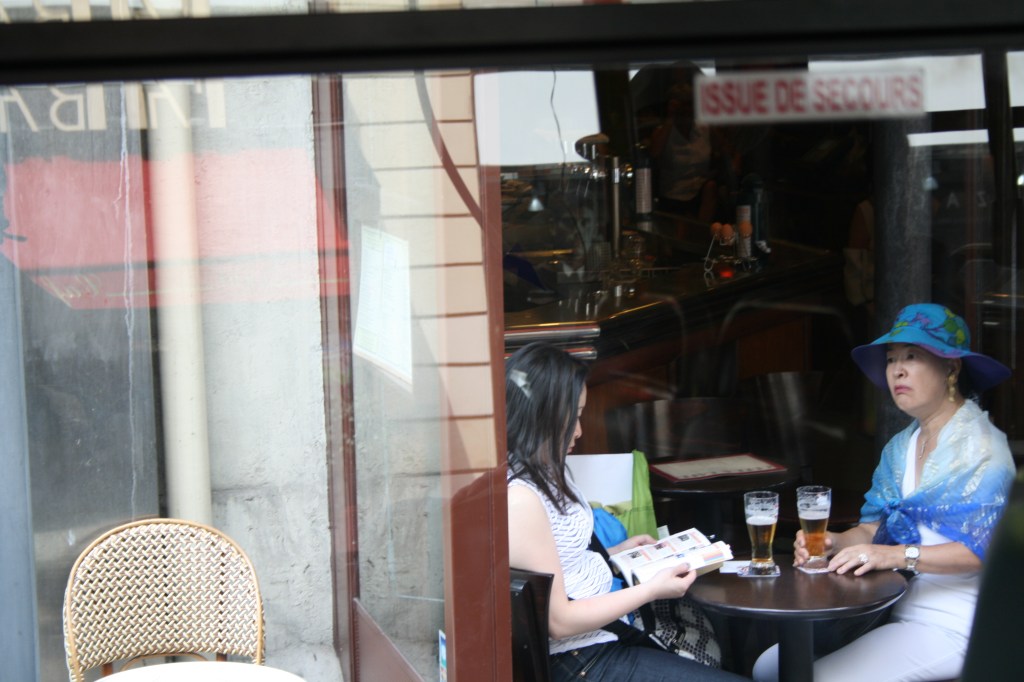
Here is another snippet of the conversation between the mother and the daughter.
“She told you that?” Laurence squeezed Catherine tighter. “No Granny won’t grow wicked. But take care when you see her ; don’t look as though you knew she was unhappy.”
“I wish you weren’t unhappy either, so I do,’ said Catherine.
Laurence agonizes about what to tell her daughter. The narration sometimes is in the third person and at other times is in the first person.

‘ Essentially what Lucien said and what Papa said coincided. Everyone was unhappy : everyone could find happiness –the one amounted to the other . Can I explain to Catherine that people are not so unhappy as all that since they cling to life? Laurence hesitated. It’s the same as saying that unhappy people are not unhappy. Is that true? Dominique’s voice all broken with sobs and cries : she loathed her life, but she had not the slightest wish to die : that is unhappiness. And again there is that emptiness, that void which freezes your heart and which is worse than death although you are preferring it to death so long as you do not kill yourself. I went through that five years ago and I still feel the horror of it . And the fact is that people do kill themselves –he asked for bananas and a towel – because in reality there does exist something worse than death. That is what chills your spine when you read an account of a suicide : not the frail corpse hanging from the window- bars but what happened inside that heart immediately before.’
Laurence sometimes feels like she does not belong to the group she is with. She is married to an ambitious architect who wants to send Catherine to a psychologist when her grades at school drop. One day in order to avoid running into the cyclist who shot in front of her car, Laurence crashed their car in the ditch. Her husband was upset with her for wrecking the car that would cost a large sum of money to repair. Laurence later reflected that Jean- Charles had something to cross about as he was sitting in the suicide seat. Laurence’s mother, Dominique who is in her early 50s is not impressed with her father who has not advanced in his legal career. After their divorce, Dominique had a suitor who subsequently left her for a 19-year- old and she was devastated despite having a successful career. To Dominique, a woman is nothing without a wealthy man in her arm.

Les Belles Images by Simone de Beauvoir is a simple story about an upper middle class family living in Paris in the sixties. I read the book decades ago and picked it up again over one weekend a decade ago and wrote a post on it then. I came across the old post written in August 2014 and decided to re-post the novel here. The story in some respects are still very much relevant. The story Les Belles Images is about how we may be at risk of becoming vacuous and vain as we chase after progress and material goals. If you pay attention there are plenty of things that you can rejoice, they need not be achievements or any milestones in life.
 Bookaholic Macchiato
