
I know nothing about the world of investment and wealth-building. I do not know much about stocks and bonds even though I have acted for Securities firms in recovering some contra losses that were due and payable by traders. That was in the late nineties and at the turn of the millennium.
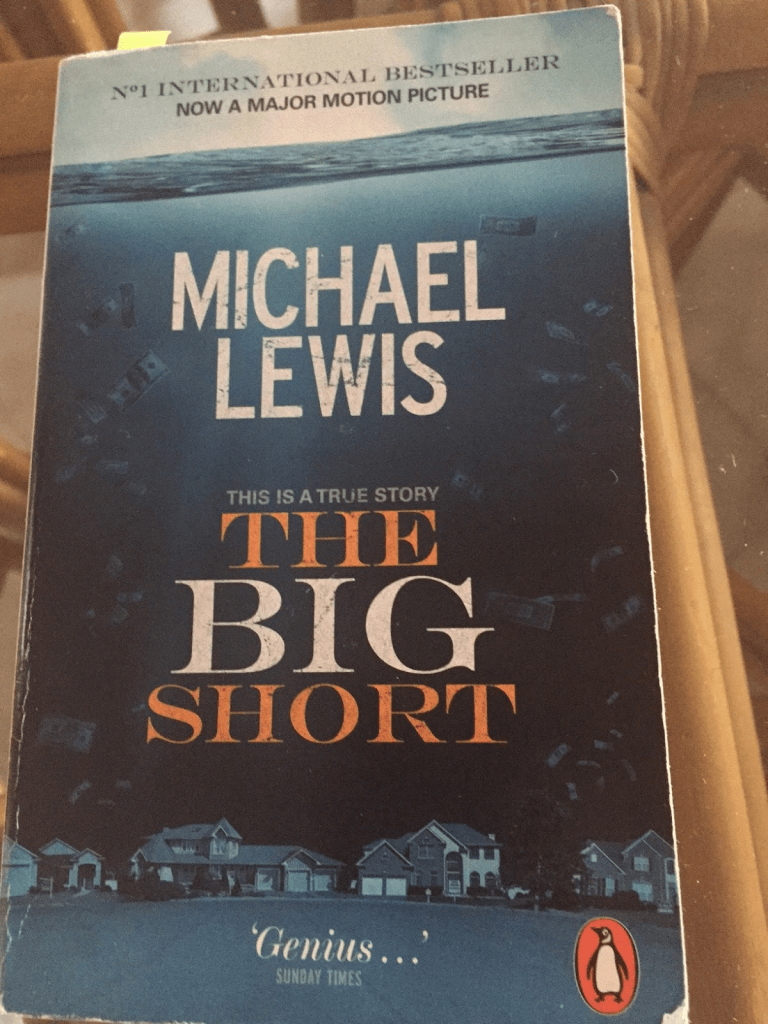
I read The Big Short by Michael Lewis almost a decade ago. It is about how a group of investors foresaw the collapse as they recognised the inherent risk in the financial products being created around subprime mortgages for the housing market. They then profited from the 2008 financial crisis by betting against it. Here are some notes I made about the book then.

In his book, though Lewis tries to narrate the stories in a way that the lay readers can understand, I still have trouble figuring out the entire financial system except that there are a lot of manipulations and inaccurate ratings. The Big Short features a few odd balls who were savvy and possessed the prescience about the flaws in the mad-cap finance world and they were the smart hedge fund guys who made colossal sums of money for their clients and themselves.It is apparent from the book that the financial system can be manipulated and trading is a form of gaming. The book exposes the folly of the system and tells how some of the insiders who work in banking industry had no clue about what was going on while it was going on. Lewis tells the story through the eyes of people who paid attention and who knew that a financial disaster was inevitable. There were smart people who knew how to make a lot of money with the system that was screwed up. But is it wrong for these smart people to game the system and ultimately made a fortune off what they foresaw was a financial disaster ?
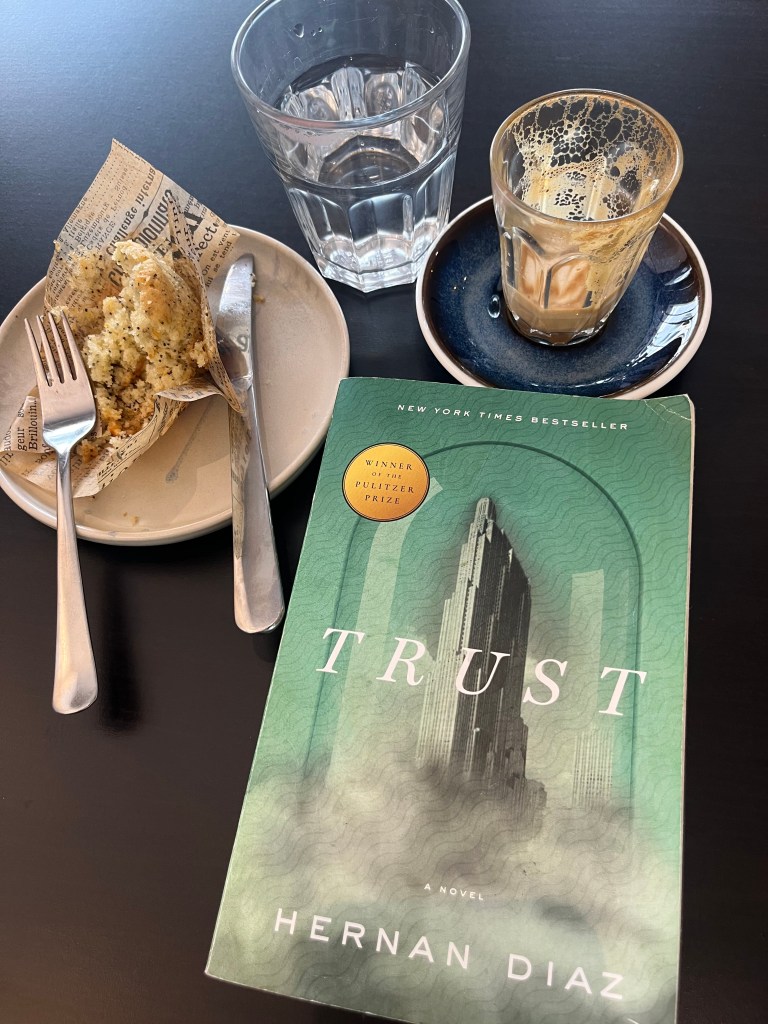
Trust by Hernan Diaz is a work of fiction about a legendary Wall Street tycoon and his wife , who is the daughter of eccentric aristocrats. It is also a story about a successful writer who has been engaged to ghostwrite the tycoon’s autobiography.
There are four accounts about Andrew Bevel and Mildred.

In Part 1 , Bevel and Milred are portrayed as Benjamin and Helen Rask in ‘Bonds’, allegedly a novella written by Harold Vanner. In that version ,Benjamin was born with family wealth that was founded in tobacco business. ‘According to the back of Rask family bible, in 1662 his father’s ancestors had migrated from Copenhagen to Glasgow , where they started trading in tobacco from the colonies.’ Their business ‘prospered and expanded to the extent that part of the family moved to America so they could better oversee their suppliers and control every aspect of production‘. Three generations later, Benjamin’s father, Solomon then bought out all his relatives and outside investors and became one of the most prominent tobacco traders. His father died of heart failure during his senior year and his mother died shortly after. Benjamin was socially awkward and a loner. He excelled academically but ‘ an inept athlete, an apathetic clubman, an unenthusiastic drinker, an indifferent gambler and a lukewarm lover‘. While he owed his fortune to tobacco, he did not smoke.Benjamin had no interest in the family trade and by chance, he found his passion in finance. Through some “connections”, his banker had been able to subscribe to bonds issued to restore the nation’s gold reserves, and had turned a handsome profit and caused spontaneous growth of his inheritance. ‘Soon he became adept at reading the ticker tape, finding patterns, intersecting them, and discovering hidden causal links between apparently disconnected tendencies.’ He started trading on his own account and took the reins of his affairs. ‘If asked, Benjamin would probably have found it hard to explain what drew him to the world of finance. It was the complexity of it, yes, but also the fact that he viewed capital as an antiseptically living thing. It moves, eats , grows, breeds, falls ill, and may die.’ He had clearly found his calling.
Rask’s wife, Helen, was also a bit of a recluse and since young she had an aptitude for languages, numbers, biblical hermeneutics, and mystical intuitions. She eventually died of a mental health treatment. Rask was devastated. While he remained an effective investor, and was capable of some creative flair now and then, ‘there was a widespread perception that he was in frank decline, that there was something stale about his approach. Nothing came close to the margins of his golden days.’ Most agreed that ‘ he had lost his touch. His mystical aura had faded.‘

Part II is an autobiography by Andrew Bevel, entitled ‘My Life’ written in 1938. Bevel offers the narrative of his life to the public primarily to counter the narrative in the story ‘ Bonds’ and to preserve the memory of his wife. In his words,
‘Mildred was the quiet, steady presence in my life that made so many of my achievements possible. I take it to be my duty to ensure that her memory does not fade and that her placid moral example endures through time. I offer here my wife’s loving portrait, resigned to knowing it shall fail to fully honor her dignity, candor and grace.‘
Bevel attributes his financial success to his intuition and understanding of the structure and workings of the financial world. It appears that he had thrived and reaped profits despite the 1929 crash, thus his investment practices became questionable to some. He wants to manage the public perception of him through his autobiography.Bevel also feels that the overall entrepreneurial spirit must be raised amongst the fellow countrymen.
In Part III entitled “A Memoir, Remembered”., Ida Partenza, now 70 years old, a successful writer in her own right, recalls her time with Andrew Bevel almost half a century ago. Following the death of Andrew , after a protracted litigation over his estate, renovation works finally started to turn Bevel House into a museum and is now open to the public. Bevel House is where Ida first became a writer. She now revisits the building and walks into her memories.
In Ida’s voice ,
‘In more than one way I owe the fact that I am a writer to the Bevels even if Mildred had been dead for several years when I first met Andrew. But I have never allowed myself to tell the story that links me to them. Possibly because I was still afraid of Andrew’s retaliation, even beyond the grave. But more likely because I have always felt, in an inarticulate way, that my relationship with Mr. and Mrs. Bevel is one of the two or three sources from which all my writing springs – another of those sources is, more predictably, my father.‘

It is 26 June 1938, twenty-three year old Ida lives with her father, a printer and they are behind with rent and in debt. She answers an ad and ends up acing the interview at Bevel Investments. She has been hired by Andrew Bevel to ghostwrite his autobiography. Aside from topping as an extraordinary stenographer and typist, one of the tests is to write a little essay about herself and the story she has made up for herself has gotten her hired.
When Ida is first hired, she is given a copy of the novella ‘Bonds’. Bevel does not like how he and his wife are depicted in ‘Bonds’ , a successful 1937 novel that all of New York seems to have read. With his money comes power. He has his attorneys to take care of Mr. Vanner and he opines that the ‘fiction demands to be countered with facts‘. In writing his autobiography, he wants Ida to help him write it but he does not allow Ida to do any independent research. He even stops her in using details she has found about Mildred’s life. He insists that she be portrayed as a sweet and demure wife purportedly to preserve her image and her memory so that ‘She- her image , her memory -won’t be desecrated‘. In the course of her research, she cannot find any book by Vanner in the New York Public Library even though ‘his early work had been somewhat successful, and Bonds had been widely reviewed‘.To ensure the efficiency of the memoir’s progress, Bevel insists on Ida moving closer to his home. He dies before Ida finishes his story.
Ida is intrigued by who Mildred might have been.
Almost half a century later she gets her hands on the ‘archival boxes containing file folders that ,in turn , contain papers, documents and little parcels wrapped in brown papers tied with twine…’ Amongst these papers are engagement books, Mildred’s journal, ledger book relating to the Charitable Fund and letters addressed to Mrs. Bevels. Ida deciphers Mildred’s handwriting that is hard to read. She learns how profoundly different she was from the “accessible” character her husband has asked her to create. Ida muses :

‘She could not have been the haunted woman in Vanner’s last chapters.And I always knew she was not the insubstantial shadow in Beverl’s unfinished memoir. ‘
‘I find it hard to forgive myself for having helped him perpetrate that fiction, even if it remained unfinished and unpublished.’
Ida skims the documents and in the last box, and finds a slim notebook wedged into the middle section of the ledger. On the cover of the notebook is the word ‘Futures’.
Part IV of the novel entitled ‘Futures’ contains Mildred’s diary and from these journal entries, you know that Mildred’s health is failing and Andrew travels frequently for his work. Mildred is kept busy with music and charity. She journals how she gives Andrew financial advice.
In Mildred’s voice,
‘ But with a tinge of caution, I sometimes had to find new ways for him to adopt my ideas.They had to become his thoughts first. Call and response: I gave him DF#EA so he could think he’d come up with AEF#D on his own.’
‘In 1929, everyone heard DF#EA and , listening ahead,thought AEF#D. But when I heard DF#EA, the response ringing in my mind was GCBb D‘
The question posed is whether Mildred, not her husband Andrew Bevel, who was the mastermind behind his financial success.
While Mr and Mrs Bevels seem larger than life, Ida Partenza comes across grounded, sensitive and a fascinating character. Diaz’s prose is brilliant and the voices are so distinctively different in every part. I particularly enjoy reading about Ida’s story and her relationship with her father who is a self-described anarchist and an exile. Her father who hails from Italy claims that he had not come to to the United States to prosper and there is the conversation between Ida and her father about money and Wall Street.

Her father quotes Marx though he does not like Marxists.
‘ Money is a fantastic commodity. You can’t eat or wear money, but it represents all the food and clothes in the world. This is why it’s a fiction. And this is what turns it not the measure with which we value all other commodities. What does this mean? It means that money becomes the universal commodity. But remember : money is a fiction;commodities in a purely fantastic form, yes? And this is doubly true for finance capital. Stocks, shares, bonds. Do you think any of these things those bandits across the river buy and sell represent any real, concrete value? No, they don’t. Stocks, shares and all that garbage are just claims to future value. So if money is fiction, finance capital is the fiction of a fiction. That’s what all those criminals trade in : fictions.’
Once her dad ‘went on one of his tirades, he could never be contradicted. He was untroubled by the possibility of error ; he never considered different perspectives, he seldom thought there could be another side to any issue.’ Her dad claims to be an anarchist, is an authoritarian when comes to his beliefs and there is no room for dissent. He detests finance capital and he views that as the source of every social injustice.
Ida response to her dad would typically make him angry.
‘ But if they trade in fictions, how can they be criminals? Fictions are supposed to be harmless , aren’t they?”
” You see the contradiction, right?”
Her dad would then respond,
” Fiction harmless? Look at religion. Fiction harmless? Look at the oppressed masses content with their lot because they have embraced the lies imposed on them. History itself is just fiction – a fiction with an army. And reality? Reality is a fiction with an unlimited budget. That’s what is it. And how is reality funded ? With yet another fiction : money. Money is at the core of it all. An illusion we’ve all agreed to support. Unanimously. We can differ on other matters. like creed or political affiliations, but we all agree on the fiction of money and that this abstraction represents concrete goods. Any goods. Look it up. It’s all in Marx. Money, he says, is not one thing. It is, potentially , all things. And for this reason it is unrelated to all things.’
After having such exchange with her dad countless times, Ida decides to tell her dad about her job interview with Bevel Investments because they need the money. In light of the nature of her assignment , she cannot share with her dad specifics of her employment.
Trust by Hernan Diaz is not an easy read. Contrary to its title, whose narratives do we Trust? You as the reader will have to piece together the story from the overlapping narratives that offer competing accounts about the same characters and events. Trust is essentially about who is in control of the narratives and it is multi-layered. Diaz’s prose is brilliant and the voices are so distinctively different in every part. I absolutely enjoy the part about Ida’s musings. It is a highly commendable read.
Hernan Diaz co-won the 2023 Pulitzer Prize for Trust together with Barbara Kingsolver for Demon Copperhead
There is an interesting conversation between Hernan Diaz and Dua Lipa.


 Bookaholic Macchiato