
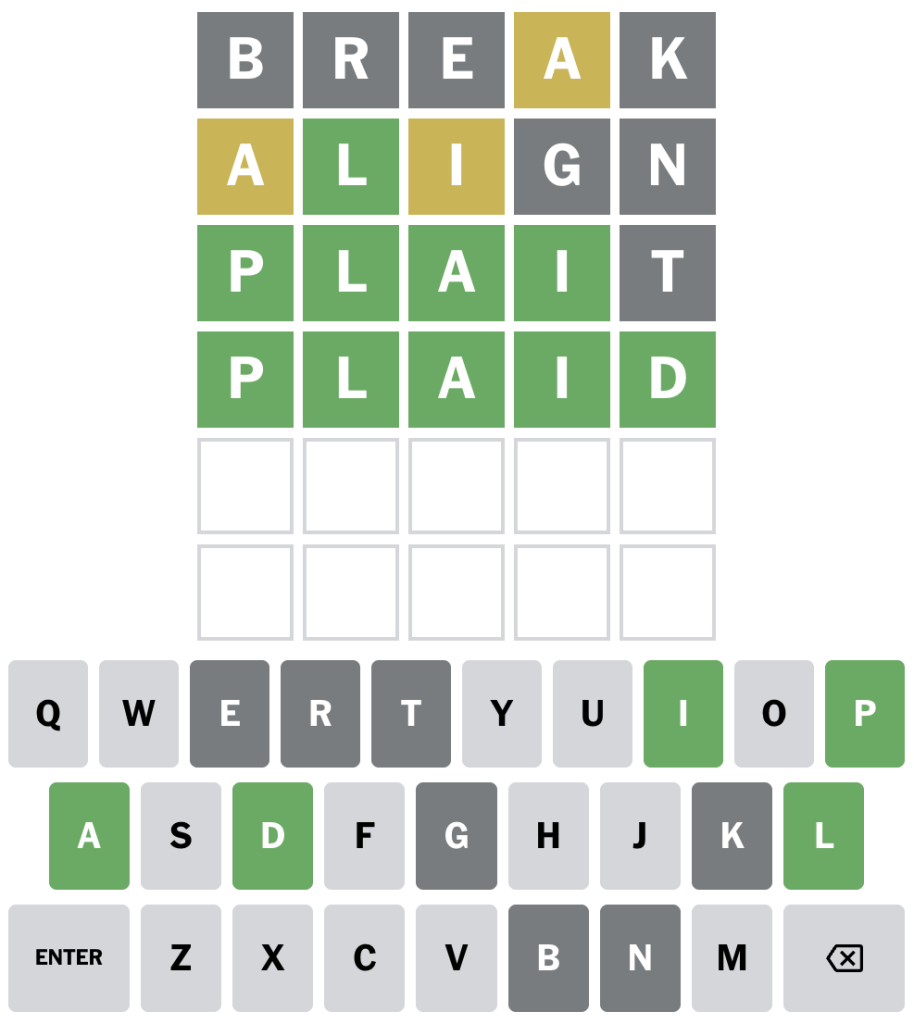
One morning when I did wordle, I had a hunch that the word would end with the letter ‘ d ‘ but I went with a ‘t’ because I wanted to find the thread between the answer and ‘BREAK’ the word I started with. I wanted it to be ‘plait’ so that it would be break a plait and not a plaid. Nothing consequential. It was just a matter of completing in three steps instead of four. For the rest of the day, I decided to adhere to what first came to mind. Often our intuition serves us well if we pay attention and when we are mindful. Intuitive clarity comes with a calm mind.
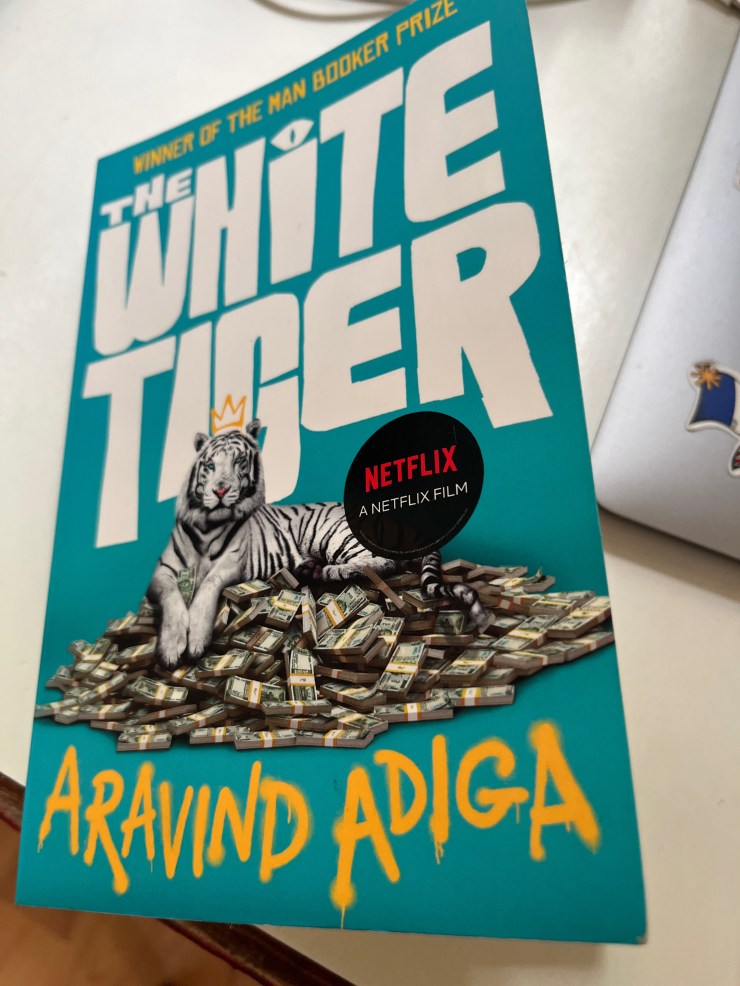
In February when I met up with my good friends from varsity days, I was gifted a copy of The White Tiger by Aravind Adiga. I’m glad that I’ve finally read it. Though it is dark funny, I did not enjoy it that much. The story is about corruption, religions, poverty and caste system in India. Meet Balram Halwai, the ‘White Tiger’ servant and driver of a rich village landlord. Balram was born in Laxmangarh, a backwater village on the River Granges. His father, a rickshaw-puller and his mother who died young believe that he should finish his schooling as he is smart and has demonstrated his potential. But he is taken out of school at a young age to earn money to pay for his cousin’s dowry. He works in a teashop, crushing coal and wiping tables, and in the meantime nurses a dream of escape. While working at the teashop, he overhears a conversation that drivers get paid well. He persuades his grandmother to give him money to learn how to drive and he succeeds in obtaining a licence to drive. Then he manages to get hired as a chauffeur for Mr Ashok and his wife, Pinky Madam who have recently returned from America. He even lands himself as the assigned driver to go to Delhi with his employer and his wife Pinky Madam.
The story is narrated in Balram’s voice in a letter addressed to the Chinese Premier, Wen Jiabao. It is written in seven consecutive nights, purpose of which is to tell the visiting Premier ‘the truth about Bangalore‘ and about entrepreneurship in India. He is a self- described entrepreneur and he explains how he has skilfully escaped from the trappings of his caste and his family. He now runs a taxi company with a website.He is actually a wanted man as he has murdered Mr Ashok. During his employment with Mr Ashok, at one point, he was the stand-in for a hit and run accident that Pinky Madam was responsible for. He was made to sign a confession. In his voice,
‘The jails of Delhi are full of drivers who are there behind bars because they are taking the blame for their good, solid middle-class masters. We have left the villages, but the masters still own us, body, soul, and arse.’

According to Balram, had he gone to jail, his family would actually brag about how he has gone to Tihar jail for his employer as he is loyal and the perfect servant. Thankfully, he does not have to serve any jail sentence because no one has reported seeing the acciden . Then as his employer Ashok becomes increasingly involved in bribing government officials to take care of the family coal business, Balram sees how his employer delivers bags of money to the government officials to avoid paying taxes. Ashok’s family has been illegally selling coal out of the government’s mines.
Balram writes:
‘When you’re the driver, you never see the whole picture. Just flashes, glimpses, bits of conversation – and then, just when the masters are coming to the crucial part of their talk – it always happens.‘
He desperately needs to escape the ‘Rooster Coop’. While Ashok is a reasonably kind boss, he can never change his life. When Pinky leaves her husband and returns to America, he sees how Ashok goes drinking and reconnects with his former lover. He also sees how his boss carries bags of money to bribe the politicians. He devises a plan to escape his oppressed life. He kills Ashok, steals his money and flees to Bangalore.
I do not particularly like the narrator’s voice, but it is authentic and effective in delivering the story about Balram who was first called Munna ( a boy) when he was born. The name Balram was given by his teacher and he was nicknamed “The White Tiger” by a school inspector who was visiting the school. The inspector was surprised by his intelligence and wanted to send him a scholarship. By analogy, the inspector called him the white tiger, a rare creature in the jungle. Sadly he had to quit school to work for his cousin sister’s dowry. He may be lacking a formal education he knows by heart the works of great poets like Rumi, Iqbal, Mirza Ghalib.
The prose is unembellished and at times peppered with humour such as this:

‘The dreams of the rich, and the dreams of the poor- they never overlap, do they?’
See, the poor dream all their lives of getting enough to eat and looking like the rich. And what do the rich dream of?’
Losing weight and looking like the poor.’
Balram muses that he might want to venture into real estate next. He thinks that after three or four years in real estate he might sell everything and ‘start a school – an English language school – for poor children in Bangalore. A school where you won’t be allowed to corrupt anyone’s head with prayers and stories about God or Gandhi-nothing but the facts of life for these kids. A school full of White Tigers, unleashed on Bangalore.‘
The poster description of him is five feet four , thin and small. He is no longer that. Balram sometimes thinks that he will never get caught but even if he gets thrown in jail one day, and gets hanged, he has no regrets about what he has done.
In his words,
‘I’ll say it was all worthwhile to know, just for a day, just for an hour, just for a minute, what it means not to be a servant.‘
The White Tiger, a debut novel by Aravind Adiga was published in 2008 and won the Man Booker Prize that year. There is a Netflix film adaptation of the book. It is a thought-provoking satire.
 Bookaholic Macchiato