There is the English proverb ‘Blood is thicker than water’ which means that familial bonds will always be stronger than other relationships. Confucianism emphasizes filial piety and advocates harmonious family as the foundation for a stable and orderly society.
In reality we know that some people struggle to find the connections at home. Familiar expectations can lead to conflict and tension between family members as such estrangement happens in relationships between parents and children and also amongst siblings.

“All happy families are alike; each unhappy family is unhappy in its own way” is the opening line in Anna Karenina by Leo Tolstoy.

In The Metamorphosis by Franz Kafka, Gregor Samsa, a travelling salesman wakes up one morning and finds that he has been transformed into a hideous and monstrous vermin; due to his grotesque physique, he is held prisoner by his family and remains hidden in his room. Sadly, he has become an object of disgrace to his family despite the fact that he has been the sole breadwinner prior to him becoming a huge bug. As he retains the human faculties of thinking and feeling, he suffers emotionally and feels helpless. He gradually goes to his ruin and annihilation.
The Metamorphosis is indeed a harrowing fable about alienation and isolation.

In the literary world, Marian Keyes‘s novels about the lives of the Walsh sisters certainly make such pleasurable reads . The Walsh family is very much a matriarchal family where the mother watches soap operas, does not cook nor hoover. Their dad is outnumbered by the women who can be loud, chaotic and dysfunctional but they are loving and supportive to one another.
Closer to home, here is a story by a debut novelist set at the turn of the 21st century in Singapore.

Imagine you have been the only child in the family and for seven years you live with your parents together with your paternal grandmother who believes that her husband had been ‘politically “disappeared” and presumably dead.’ Your dad has thus been brought up by his mother single-handedly. One day a stranger starts writing to your grandmother claiming that he is your grandfather’s son and subsequently shows up as your dad’s half brother. He brings his youngest daughter and leaves her with your family. This is the story of Genevieve Yang Si Qi in The Original Daughter by debut author, Jemimah Wei.
The Original Daughter, the debut novel by Jemimah Wei is a story that examines family bonds, familiar love and societal expectations.
The year is 1996. Genevieve Yang Si Qi, aged eight is living with her parents and grandmother in a single-room flat , one of the oldest Housing Development Blocks located within Bedok’s Fengshan Estate in Singapore.
One evening in May, right before dinner, her grandmother tells her family that her husband who had been ‘politically “disappeared” and presumably dead.’ ‘had actually been thriving this entire time in Kedah, Malaysia‘. He recently died, leaving behind a son, daughter-in-law and grandchildren.
HIs other family is unable to raise all his grandchildren and his other son, Wei Qiang reaches out to Genevieve’s grandmother for help in raising his youngest daughter, Arin. This is how Arin Yang Yan Mei, aged seven comes to live with eight-year-old Genevieve. That is how Genevieve’s father Wei Ming finds out about his father’s other life.
Genevieve assumes the duty as a “Jie Jie”, an older sister, seriously. At home her grandmother is struggling to make sense of her husband’s betrayal thus she is unable to accept Arin as her granddaughter.
As the story progresses, you learn that Genevieve’s mother , Su, once a promising college student, is disowned by her parents for getting pregnant and dropping out of school. She marries a man they disapprove of and that man, Genevieve’s father, as it happens, also has been previously abandoned by his father. While her father seemingly takes this injustice in stride, he works extra hard to provide for the additional family member when they adopt Arin.
Growing up, the two girls become collaborators and inseparable. At school Genevieve stands up for Arin and both her and her mother help Arin to catch up with her studies. But as Arin grows close to her mother and thrives in school, Genevieve begins to see that her place at home and in society threatened particularly when she falls behind in her studies and subsequently does poorly in her A levels examinations. After acing the O levels, Genevieve enters a school reputed to be most brutal and the most prestigious. Unfortunately she has difficulties coping at school. During that time, something happens between her parents, her father abruptly leaves the family. Su, their mother’s optimism somehow alienates her husband instead of binding the family.
In Genevieve’s voice,
‘As for me, the abrupt nature of my father’s departure ripped open a vortex into which my anxieties, my awareness of my classmates, and my panic at my own ignorance vanished; without looking too closely at it, I turned back to my books as one would an oxygen line. It was like being drugged – I made more headway in that eleventh hour than through the panic of the last two years, ad went into the A levels feeling not as if I were scrambling to prove myself but simply meeting my fate.‘

When Genevieve cannot secure a place in any of the local universities, things begin to go downhill for her. Arin has chosen to attend a different school and perhaps she is ‘terribly frightened by’ her cousin’s failure, she ends up studying hard with calm determination. She has also adapted better to junior college and manages to throw herself fully into school and work.
Genevieve first supports Arin to accept the YouTube role by providing Arin some money and help with her overall appearance and gestures. Arin proves to have screen presence ‘How naturally her shyness glinted into a staggering self-possession, how intelligently she wielded it against Lyla’s sharp wit and hot takes.’
Arin’s YouTube performance is well received. One day Arin is cast in a local Indie film. To Genevieve, it feels as if she had been training Arin for her screen performance her whole life. In her voice,
‘I had helped Arin, just not in the way I’d thought.’
In 2010, Genevieve wants to get away so she takes up a job as a secretarial assistant in Christchurch, New Zealand. When she shares with Arin her incident of being physically assaulted, Arin applies Gen’s traumatic experience in her acting debut. Gen thus finds that unforgivable. As Arin pursues her ambition and rises exponentially, Genevieve gets left behind.
Genevieve starts off as a self-assured and almost arrogant child somehow grows up to be such a glum, self-destructive and defeatist character. It can be infuriating to read about her dejection though you can empathize with her pain as she braves herself to hear Arin’s A levels results.
In Genevieve’s narrative ,
‘But despite all my practice, my confidence faltered. I ‘d been dreading this day for so long. As the anniversary of my failure drew close it became harder and harder to pretend at normalcy, now it had arrived and there was nowhere to run. Arin looked at me, worried. ” I got a perfect score.“
Something small died, deep in my soul. ” I knew it.”‘
When Genevieve hears about Arin landing a role in a film, she cannot stop feeling envious and jealous, her mind is fed with poisonous thoughts.
‘ So she was thriving. How clear it was ,suddenly, that I’d been demoted not from associate to accessory, as I’d assumed, but to encumbrance: Had my absence unclipped her wings? How far would the shadow of her success spread? Would she not stop until she had the entire world at her thrall?‘
Perhaps Gen’s downfall is to do with expectations and a sense of entitlement. While Arin can be self-absorbed at times, she comes across more resilient despite having been casted off by her original family. After reconnecting with her estranged father, both Gen and her father work really hard at their meetings. Genevieve muses,
‘ But we failed each other in increasingly wretched ways. In the years since, I’ve deliberated the matter and thought that perhaps integral to all loving relationships is a necessary distance, not because of the old excuse of familiarity and contempt, but because it allows us to make sense of and articulate our stories in a manner that’s essential to our survival, whereas when we push forward in pursuit of boundless intimacy, we provide the opportunity for the other person to puncture our sense of self, to, in moments of excitement or vindication, say, no, I remember it differently, that’s not at all how it happened. And in doing so crush our self-regard in accidental, devastating ways.’
Life is very much a work in progress.
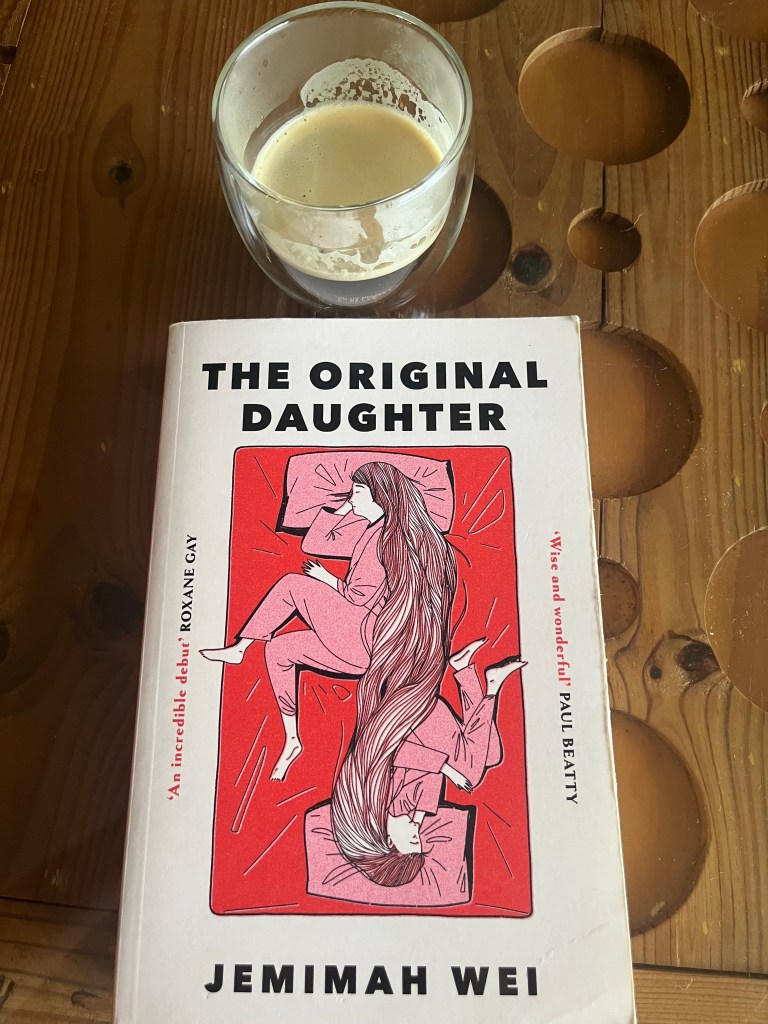
The Original Daughter by Jemimah Wei is a multi-layered story set in a specific version of Singapore where academic success is the gateway to better career opportunities.
The story is about unfulfilled dreams and how the demands of urban life requires you to shape shift and constantly strive to succeed in a winner-takes-all world. It is a story about meeting familiar expectations and finding one’s identity and a place where one belongs.
The Original Daughter is a thought-provoking read. Jemimah Wei is a talented writer.
 Bookaholic Macchiato