I always take books with me wherever I go. When my children were growing up, amidst my work, in between errands, yoga, hitting tennis and ferrying my children to classes and extra-curricular activities, I would read a page or two while waiting for them in the car. The novels that I used to read were usually contemporary fictions and not literary fictions. Most of them were not heavy reads.
There is such a lot of joy in reading fictions. My choice of reads can be eclectic because only through reading all these different writings, I feel I am able to think a little better. While I gain a little knowledge about things I do not know, I also learn that there are far too many unknowns. Not that I want to make sense of everything because often things do not make sense and they may never make sense.Through reading, one can pick up a new word, a new phrase, perhaps a new insight or be reminded of something that you have long forgotten.
Last night we met up with a group of acquaintances for dinner. The guest who was seated next to me told me about how pleased she was now that she had gotten herself a kindle although she would much prefer holding a book.
As I wrote in one of my previous posts, I much prefer the tangible, the feel of the papers and the smell and weight of the books, their bindings and the written words caught between their covers. If only more people could take to reading fictions as they show us different viewpoints about human experience across a wide range of communities. Reading fiction increases empathy and enables us to better understand the differences among us all.
I have multiple reads at any given time and I do endeavour to finish reading one fiction a week. Whenever I have a trip, I have to be selective in picking my reads as I cannot lug along too many books knowing that I will not be able to read them all.
From time to time, I read fictions about present day women in their forties or fifties and the challenges that confront them as they raise their children and having to deal with work life balance, growing old and how they might not have envisaged the way their married lives have turned out to be. I recently read A Woman’s Battles and Transformations, a memoir by Édouard Louis translated from the French by Tash Aw.
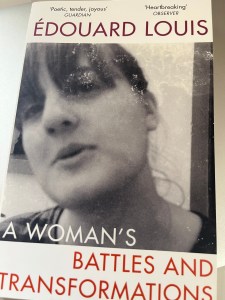
Though A Woman’s Battles and Transformations by Édouard Louis can be a one-sitting read, it is a novella that moves you as its prose is mesmerizing and the anecdotes are told with such tenderness and courage. It is a tale about the author’s mother’s liberation.It is a tribute to his mother, Monique about her pains, battles and transformation.
The narrator chances upon his mother’s photograph taken before he was born. The photo was taken the year she turned twenty. It was a time before mobile phone and the photo was taken by her using a camera, he imagined it would not have been a straightforward thing as she had to hold the camera backwards to capture her face in the lens as seen from the book cover. He muses,
‘ I think I’d forgotten that she had been free before my birth - even joyful?
It must have occurred to me sometimes, when I was still living with her, that she had once been young and full of dreams, but when I found the photo I hadn’t thought about it for a long time- her freedom and contentment had become an abstract notion, something I barely knew. Nothing , or almost nothing, of what I knew of her in my childhood, through the closeness I had with her body for fifteen years, could have helped me remember all that.
From his mother’s snapshot of herself, you see that her hair, her pose and gaze evokes freedom and the infiniteness of possibilities and perhaps happiness but when he thinks back to the life she had shared with his father between age twenty-five and forty- five, how she was constantly humiliated and how his dad was always drunk. Her mother’s story starts with a dream: she was going to be a cook. At sixteen, she enrolled herself in the hospitality school in her region but she had to quit when she found herself pregnant with a child. She got married and by the time she was twenty, she had a son and a daughter. Though her marriage was not good, she stayed because she did not want her children to grow up fatherless. She finally divorced when she figured that her husband was sleeping with other women. Then a few months later, she met the writer’s father.They fell in love and moved in together. Sadly very quickly, he became someone just like all the others. With him, she could never tell if it’s going to rain or shine and he stopped her from wearing make-up and expected her to do the cooking and cleaning for the entire family. He did not want her to get her driving licence and he came home late and his entire body soaked in alcohol.
Growing up, the writer had his own issues to deal with. It was a norm for men to go to the café with his buddies who often took their sons, but his father, ashamed of him and his feminine mannerisms, never took him. One day at work, a heavy weight had fallen and broke his father’s back. As he could no longer work, his wife had to work as a helper, washing elderly people in the village to earn some money. Now that he stayed home all day, life became more insufferable for her.
‘What is a man? Virility, power, camaraderie with other boys? I never had any of that. The absence of the risk of sexual assault? I was never protected from that.’
The writer gradually understands his mother’s life. He was fortunate that he could leave home when he went to lycée (French secondary school). He was the only person from his family to have had an education. Coming from a working class family, when he went to school and later university, he had to adapt to a different world .
Just as he had resigned to the fact that his mother’s life was her destiny and that her life was about going to the grocery store, preparing meals, having children who were merely reproducing her life, living in the countryside, putting up with her husband’s nastiness, everything changed. One night, he received a call from his mother who said to him : ‘At last. I’ve done it.‘
He understood immediately what she meant.Finally at the age of forty-five, his mother frees herself from oppression to start a new a life in Paris.
It is only 115 pages but the feelings that its narratives evoke are unsettling and powerful. A Woman’s Battles and Transformations by Édouard Louis translated into English by Tash Aw is a novella that I would read again.
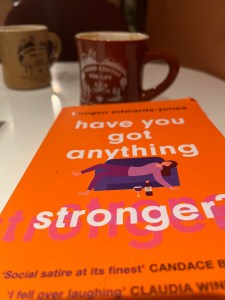
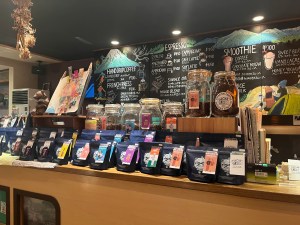
In October, one of the fictions I had brought along with me when I was travelling to Niseko and Tokyo was Have you got anything stronger by Imogen Edwards- Jones. We stayed at a newly completed resort apartment in Niseko. As it was not yet skiing season, the cafés that I wanted to check out in the vicinity were not open, we ended up driving around checking out places in Hokkaido, drove into the city and chilled at Sprouts, a quaint café in Kutchan. Though I had managed to read on the plane and while waiting to board the plane, I did not manage to read as much as I had wanted to partly because I could not help catching some of the in-flight movies that were available.
Have you got anything stronger is a satire. Its narratives are quite relatable. The story follows a year in the life of four best female friends in their forties as they navigate husbands, children, love, sex, money and careers ( what’s left of them).
The story is narrated in Jane’s voice and today is her birthday. It is September 9th. She is forty-six years old. Two days later, she meets with her friends Claire , Sally and Kate to celebrate her birthday.
Jane used to work full time and now she is a stay home mom but she is about to return to the work force. Her daughter , Ella, fifteen, is full of teenage angst and Sam is nine years old. Sally has three boys under the age of six so she tends to swear a lot. She is so desperate for a lie-down that she wishes for a mild concussion or falling sick to put her out of action for a while . Claire is getting a divorce and Kate is glamorous , single and works in advertising.
In Jane’s narration,
‘Guitar, tennis,drums,swimming, cricket,rugby,coding.Football, remedial maths, remedial English, remedial science,remedial French, parties,”gatherings”,”motives”:my children have more bloody appointments than the Foreign Secretary and I’m the chauffeur. I did have a life and career once, but now I simply drive up and down the Kilburn High Road, my shoulders rounded, my mouth ajar, listening to Magic or Tragic FM as my children call it. All I need is a nodding dog and a mustard-velvet-covered box of tissues on the back shelf of my car and I could start charging.
But it is not so much the driving, which I obviously hate, but it is the hanging around outside the class, lesson, boot camp, remedial centre that really pisses me off. What are you supposed to do for those forty-eight minutes of freedom? Send emails? Text people ? Google famous people? Read a newspaper/book? Phone Radio 5 Live and join in the heated debate?‘
These married women ask themselves:
‘Between running late, meetings, pick-ups and drop- offs, it’s clear the hamster wheel never really stops turning and the question eventually must be asked . . .
Is this it?’
Jane has an overbearing mother, Jacqueline who tends to compare her with her older sister , Jenny who is married with Dan. They live in Byron Bay, Australia with their two children, Coral and Josh.
‘Jacqueline despises food and the weakness in those who use it. She seems to have survived thus far in life on a diet of dust and gin. She always claims that she was named after Jacqueline Kennedy because she was so glamorous, although the fact that she was built like a swizzle stick and injected her arse with amphetamines every morning to keep thin was something she also embraced. The “no woman can ever be too rich or too thin” ethos of the charming Wallis Simpson was also one of her little mantras we heard when growing up.’
For the past forty years,Jane’s parents have been hosting Boxing Day drinks party for their neighbours even though they both hate doing it yet they do it anyway. Jane and her sister, Jenny used to think that being an adult was all about doing things you hated doing. Now that she is an adult, she concludes that ‘being a grown-up is about getting through a series of events you don’t want to do, but you can’t think of a good enough excuse to get out of them.’
The Bowens come to the party with their son, Adam. Along with everyone, Jane used to think that Adam had a crush on Jen when it was her with whom Adam was in love. The present Adam is completely different from how he was in his teens : ‘Visibly uncoordinated, he was the sort of boy you tried to avoid dancing with at parties.’ He is now tall and has a rather good looking figure and career wise, he is the CEO of an offshore investment company and is based in Hongkong. That prompts Jane to wonder about all the choices she made and failed to make.
‘ Have I just been sleepwalking my entire life? Do I live in a dull twilight of my own making?
Have I not really thought about anything?
Did I just blithely do things and not think about the consequences?
Am I just passive and inert? Am I destined to go through life like an odourless gas, leaving no trace at all ? My insignificance is total.
What is so terrifying is that if I open Pandora’s Box or take the elephant out of the room and sweep it from under the very lumpy carpet, what will I find?
An unbearable river of pain that would not, could not, stop flowing?’
-Have you got anything stronger, Imogen Edwards- Jones
After the Boxing Day party, Jane has this fight with her subconscious thinking that ‘she is not in charge of anything, she can neither choose her own direction nor her final destination.’
C’est la vie. it appears too late to crash out.
Don’t you sometimes have one of those moments when you wonder about the choices you have made or failed to make? I suppose I do have such moments particularly as the year is drawing to a close and we are about to ring in a new year. Whatever choices we have made, they come with their own set of challenges. Always look on the bright side of life, that is what I tell myself. If we pay attention to our consciousness, things will fall into place.
Imogen Edwards-Jones is the author of more than twenty books (including five Sunday Times bestsellers). She was responsible for the successful Babylon series, which sold over one million copies in the UK alone, has been translated into twenty different languages worldwide and was made into two BBC primetime TV shows.
 Bookaholic Macchiato