
“All the world’s a stage, and all the men and women merely players”
– As You Like It, a comedy by William Shakespeare.
Each of us has multiple roles in our every day life. Ideally we want to be our authentic selves and be fearless about being who we are. But given the schooling, the upbringing and the information we have had throughout our life, we normally act appropriately when we assume our various roles; be it a role that we have landed ourselves in by default, or by design according to the choices we think we have made.
This week, I learnt a new word from solving Connections. KAYFABE. It means the act is staged. It is the performative act that looks like it is real and genuine when it is not. The word started as a wrestling term initially.The performance is staged to fully engage the audience emotionally. The wrestlers have to stay in character whenever they are in public.
Kayfabe is a code that is used by the people in the wrestling business because the sport is intended to be staged and scripted despite being presented as authentic. According to Merriam Webster,
‘Inside the wrestling world, breaking the dramatic fourth wall was forbidden. The wrestlers had a code for staying in character. They called it “kayfabe.”All the contrived rivalries and storylines fell within kayfabe.—David Giddens’
In modern days, there is certainly Kayfabe in Reality TV where the line between reality and fiction is blurred.
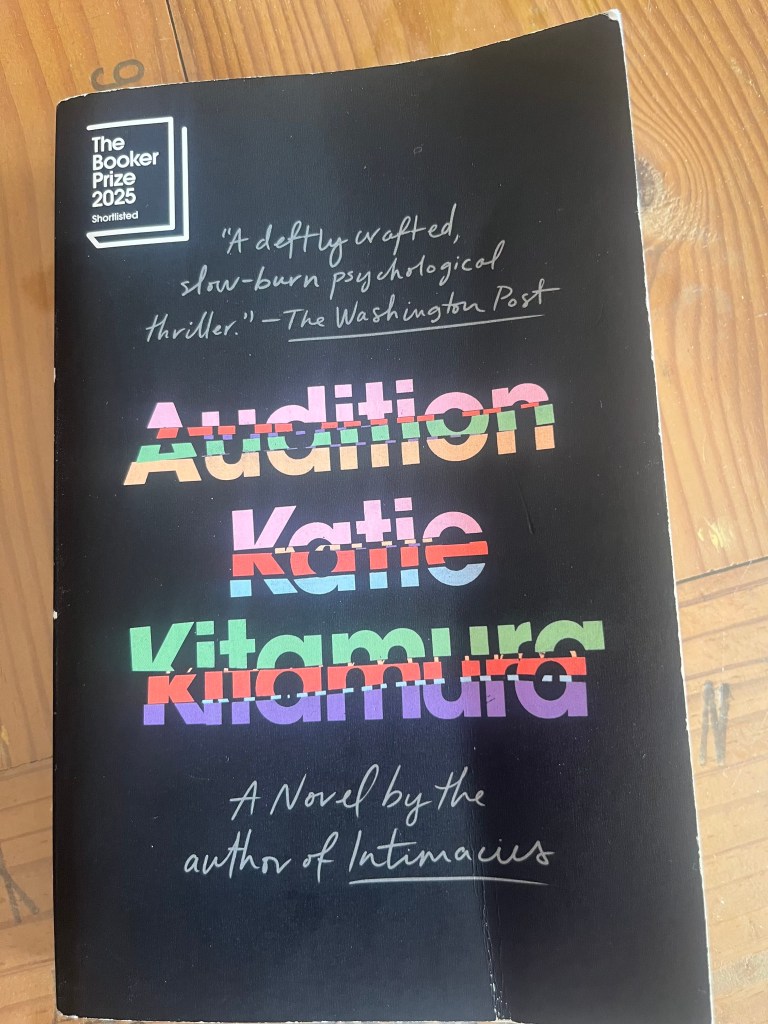
In Audition, Katie Kitamura gave two different narratives involving the same characters. The novel is made up of Part I (Chapters 1-6) and Part II ( Chapters 7- 13), with Part Two presenting a parallel universe to the world set up in Part One. In Part I, the main character is not a mother whereas she is a mother in Part II. The narrator is the main character who has not been given a name throughout the book.
In the first part of the story, the narrator is an accomplished actress and during rehearsals she seems to have difficulties playing the character she is portraying on stage to its full extent. The character is required to express grief and gradually arrive at some idea of transformation. The story begins with her meeting Xavier, an attractive young man in a Manhattan restaurant. He claims that she is his mother who tells him that it is impossible to be the case.
In the second part of the story, the narrator is Xavier’s mother. He needs to move back home. The story centres on the dynamics between her and her husband Tomas and also their relationships with their son. Enter Hana, Xavier’s girlfriend, their seemingly blissful home life face new challenges.
There are two competing narratives in the novel.
The major theme of the book is the idea of performance, in that the narrator performs as an actor professionally and also in her personal life. In Part II of the novel, the unnamed character performs her domestic duties as a wife to Tomas and a mother to Xavier.
In Part II, after all that happens, she muses,
‘ As for Xavier, I no longer knew what he was to me, or what I was to him. We had been playing parts, and for a period — for so long as we understood our roles, for as long as we participated in the careful collusion that is a story, that is a family, told by one person to another person – the mechanism had held. ‘
The author’s prose is minimal and effective.
‘Xavier looked up, not at me but at Tomas, and I saw that there was a question in his eyes. I looked across at Tomas and I knew he was not convinced, that some part of him wished to stay inside the performance, inside the fantasy, I could see the thought moving through his head and nearly settling, what was a family if not a shared delusion, a mutual construction? And equally I saw that Xavier believed that if he could persuade Tomas, then it would be the two of them, two of three, a majority that could sustain the fantasy we had agreed to live inside. But he was wrong, he overestimated his powers of persuasion, the record of these past weeks. I had years, I had an entire lifetime, to wield over Tomas, and I knew that he would not leave me, not in this regard nor in any other.’
I read that Kitamura had ‘wanted the book to be a little bit like a David Lynch film, in the sense that the effect is the effect‘. She wants to leave it to the readers to interpret the novel.
Audition by Katie Kitamura is brilliant. The author’s narratives provide moving descriptions of the dynamics and subtly changing interplay between the various characters. The novel essentially asks the question whether we really know the people we love and understand the roles we play in relation to them. It explores how we rewrite our understanding of the roles we play and it examines the truths behind our performance masks every day whether as partner, parent, colleague or muse. The book was shortlisted for The Booker Prize in 2025.


 Bookaholic Macchiato